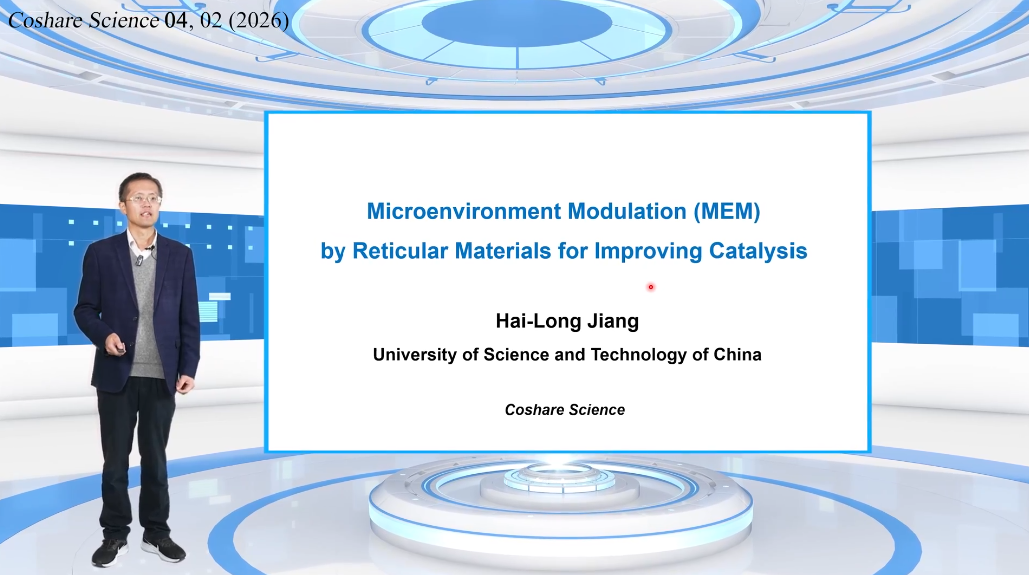
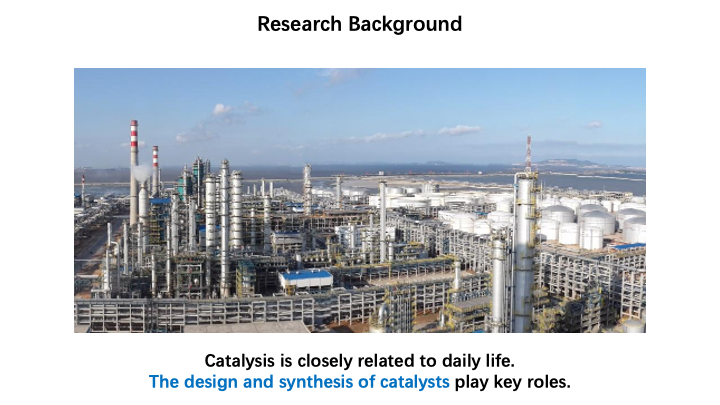
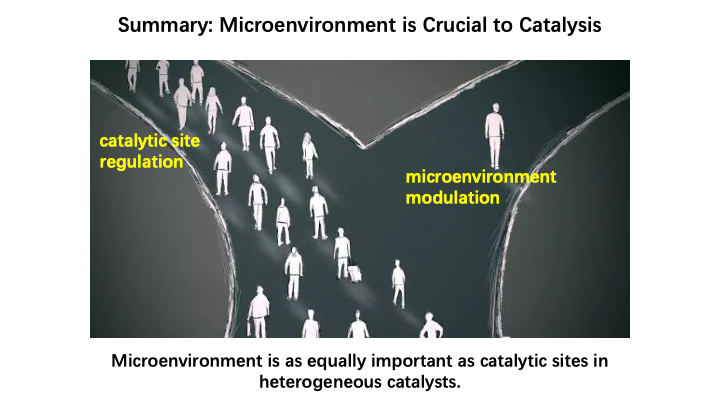
Catalyst design and optimization are central to advancing catalytic science. In both enzymatic and homogeneous systems, the microenvironment that creates distinct spatial and electronic configurations around active sites showcases profound influence on catalytic behavior. However, elucidating microenvironment modulation (MEM) in heterogeneous catalysts remains a significant challenge, primarily due to the structural rigidity and limited tailorability of conventional solid materials. Reticular materials, including metal–organic frameworks (MOFs) and covalent organic frameworks (COFs), have recently emerged as prominent candidates for heterogeneous catalysis. Their atomic-level structural precision and high degree of tunability render them ideal model systems for MEM around catalytic sites. As such, MOFs and COFs offer unique opportunities to unravel the role of MEM in governing catalytic performance. In this presentation, I will highlight our recent progress in leveraging MEM surrounding catalytic sites based on reticular materials for improving catalysis.
This work was supported by the National Key Research and Development Program of China (2021YFA1500402), the NSFC (22331009 and W2512006).
1. L. Jiao and H.-L. Jiang, Metal-organic frameworks for catalysis: fundamentals and future prospects, Chin. J. Catal. 45, 1 (2023).
2. L. Jiao, J. Wang, and H.-L. Jiang, Microenvironment modulation in metal–organic framework-based catalysis, Acc. Mater. Res. 2, 327 (2021).
3. J.-D. Xiao, Q. Shang, Y. Xiong, Q. Zhang, Y. Luo, S.-H. Yu, and H.-L. Jiang, Boosting photocatalytic hydrogen production of a metal–organic framework decorated with platinum nanoparticles: the platinum location matters, Angew. Chem. Int. Ed. 55, 9389 (2016).
4. Y. Pan, Y. Qian, X. Zheng, S.-Q. Chu, Y. Yang, C. Ding, X. Wang, S.-H. Yu, and H.-L. Jiang, Precise fabrication of single-atom alloy co-catalyst with optimal charge state for enhanced photocatalysis, Natl. Sci. Rev. 8, nwaa224 (2020).
5. Q. Yang, Q. Xu, and H.-L. Jiang, Metal–organic frameworks meet metal nanoparticles: synergistic effect for enhanced catalysis, Chem. Soc. Rev. 46, 4774 (2017).
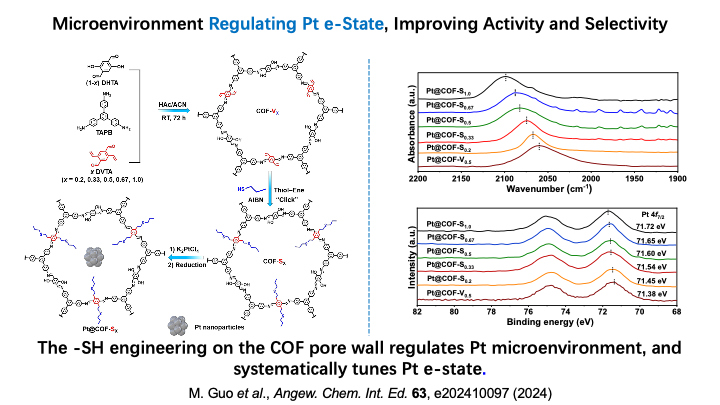
6. M. Guo, X. Guan, Q. Meng, M.-L. Gao, Q. Li, and H.-L. Jiang, Tailoring catalysis of encapsulated platinum nanoparticles by pore wall engineering of covalent organic frameworks, Angew. Chem. Int. Ed. 63, e202410097 (2024).
7. J. Wang, K. Sun, D. Wang, X. Niu, Z. Lin, S. Wang, W. Yang, J. Huang, and H.-L. Jiang, Precise regulation of the coordination environment of single Co(II) sites in a metal–organic framework for boosting CO2 photoreduction, ACS Catal. 13, 8760 (2023).
8. X. Ma, H. Liu, W. Yang, G. Mao, L. Zheng, and H.-L. Jiang, Modulating coordination environment of single-atom catalysts and their proximity to photosensitive units for boosting MOF photocatalysis, J. Am. Chem. Soc. 143, 12220 (2021).
9. K. Sun, Y. Huang, Q. Wang, W. Zhao, X. Zheng, J. Jiang, and H.-L. Jiang, Manipulating the spin state of Co sites in metal–organic frameworks for boosting CO2 photoreduction, J. Am. Chem. Soc. 146, 3241 (2024).
10. Y.-N. Gong, L. Jiao, Y. Qian, C.-Y. Pan, L. Zheng, X. Cai, B. Liu, S.-H. Yu, and H.-L. Jiang, Regulating the coordination environment of MOF-templated single-atom nickel electrocatalysts for boosting CO2 reduction, Angew. Chem. Int. Ed. 59, 2705 (2020).
11. Y. Zhang, L. Jiao, W. Yang, C. Xie, and H.-L. Jiang, Rational fabrication of low-coordinate single-atom Ni electrocatalysts by MOFs for highly selective CO2 reduction, Angew. Chem. Int. Ed. 60, 7607 (2021).
12. L.-L. Ling, W. Yang, P. Yan, M. Wang, and H.-L. Jiang, Light-assisted CO2 hydrogenation over Pd3Cu@UiO-66 promoted by active sites in close proximity, Angew. Chem. Int. Ed. 61, e202116396 (2022).
13. H. Wang, X. Zhang, W. Zhang, M. Zhou, and H.-L. Jiang, Heteroatom-doped Ag25 nanoclusters encapsulated in metal–organic frameworks for photocatalytic hydrogen production, Angew. Chem. Int. Ed. 63, e202401443 (2024).
14. Y.-N. Gong, W. Zhong, Y. Li, Y. Qiu, L. Zheng, J. Jiang, and H.-L. Jiang, Regulating photocatalysis by spin-state manipulation of cobalt in covalent organic frameworks, J. Am. Chem. Soc. 142, 16723 (2020).
15. L. Jiao, J. Zhu, Y. Zhang, W. Yang, S. Zhou, A. Li, C. Xie, X. Zheng, W. Zhou, S.-H. Yu, and H.-L. Jiang, Non-bonding interaction of neighboring Fe and Ni single-atom pairs on MOF-derived N-doped carbon for enhanced CO2 electroreduction, J. Am. Chem. Soc. 143, 19417 (2021).
16. G. Yang, D. Wang, Y. Wang, W. Hu, S. Hu, J. Jiang, J. Huang, and H.-L. Jiang, Modulating the primary and secondary coordination spheres of single Ni(II) sites in metal–organic frameworks for boosting photocatalysis, J. Am. Chem. Soc. 146, 10798 (2024).
17. M. Xu, D. Li, K. Sun, L. Jiao, C. Xie, C. Ding, and H.-L. Jiang, Interfacial microenvironment modulation boosting electron transfer between metal nanoparticles and MOFs for enhanced photocatalysis, Angew. Chem. Int. Ed. 60, 16372 (2021).
18. M.-L. Gao, L. Li, Z.-X. Sun, J.-R. Li, and H.-L. Jiang, Facet engineering of a metal–organic framework support modulates the microenvironment of palladium nanoparticles for selective hydrogenation, Angew. Chem. Int. Ed. 61, e202211216 (2022).
19. L.-L. Ling, X. Guan, X. Liu, X.-M. Lei, Z. Lin, and H.-L. Jiang, Promoted hydrogenation of CO2 to methanol over single-atom Cu sites with Na+-decorated microenvironment, Natl. Sci. Rev. 11, nwae114 (2024).
20. L. Li, Z. Li, W. Yang, Y. Huang, G. Huang, Q. Guan, Y. Dong, J. Lu, S.-H. Yu, and H.-L. Jiang, Integration of Pd nanoparticles with engineered pore walls in MOFs for enhanced catalysis, Chem 7, 686 (2021).
21. M. Guo, Q. Meng, W. Chen, Z. Meng, M.-L. Gao, Q. Li, X. Duan, and H.-L. Jiang, Dual microenvironment modulation of Pd nanoparticles in covalent organic frameworks for semihydrogenation of alkynes, Angew. Chem. Int. Ed. 62, e202305212 (2023).
22. S. Hu, J. Huang, M.-L. Gao, Z. Lin, Y. Qian, W. Yang, L. Jiao, and H.-L. Jiang, Location-specific microenvironment modulation around single-atom metal sites in metal–organic frameworks for boosting catalysis, Angew. Chem. Int. Ed. 64, e202415155 (2025).
23. S. Suleman, Y. Zhang, Y. Qian, J. Zhang, Z. Lin, Ö. Metin, Z. Meng, and H.-L. Jiang, Turning on singlet oxygen generation by outer-sphere microenvironment modulation in porphyrinic covalent organic frameworks for photocatalytic oxidation, Angew. Chem. Int. Ed. 63, e202314988 (2024).
24. H. Wang, X. Liu, W. Yang, G. Mao, Z. Meng, Z. Wu, and H.-L. Jiang, Surface-clean Au25 nanoclusters in modulated microenvironment enabled by metal–organic frameworks for enhanced catalysis, J. Am. Chem. Soc. 144, 22008 (2022).
25. H. Wang, X. Liu, Y. Zhao, Z. Sun, Y. Lin, T. Yao, and H.-L. Jiang, Regulating interaction with surface ligands on Au25 nanoclusters by multivariate metal–organic framework hosts for boosting catalysis, Natl. Sci. Rev. 11, nwae252 (2024).
26. D. Chen, W. Yang, L. Jiao, L. Li, S.-H. Yu, and H.-L. Jiang, Boosting catalysis of Pd nanoparticles in MOFs by pore wall engineering: the roles of electron transfer and adsorption energy, Adv. Mater. 32, 2000041 (2020).
27. S. Wang, Z. Ai, X. Niu, W. Yang, R. Kang, Z. Lin, A. Waseem, L. Jiao, and H.-L. Jiang, Linker engineering of sandwich-structured metal–organic framework composites for optimized photocatalytic H2 production, Adv. Mater. 35, 2302512 (2023).
28. L. Wen, K. Sun, X. Liu, W. Yang, L. Li, and H.-L. Jiang, Electronic state and microenvironment modulation of metal nanoparticles stabilized by MOFs for boosting electrocatalytic nitrogen reduction, Adv. Mater. 35, 2210669 (2023).
29. B. Liu, Y. Wu, L. Wang, H.-L. Jiang, and Q. Li, Covalent organic frameworks as infinite building units for metal–organic frameworks with compartmentalized pores, Nat. Chem. (2025).
30. S. Hu, M.-L. Gao, J. Huang, H. Wang, Q. Wang, W. Yang, Z. Sun, X. Zheng, and H.-L. Jiang, Introducing hydrogen-bonding microenvironment in close proximity to single-atom sites for boosting photocatalytic hydrogen production, J. Am. Chem. Soc. 146, 20391 (2024).
31. Y. Zhang, X. Guan, Z. Meng, and H.-L. Jiang, Supramolecularly built local electric field microenvironment around cobalt phthalocyanine in covalent organic frameworks for enhanced photocatalysis, J. Am. Chem. Soc. 147, 3776 (2025).
32. G. Yang, J. Huang, W. Gu, Z. Lin, Q. Wang, R. Kang, J.-Y. Liu, Z. Sun, X. Zheng, L. Jiao, and H.-L. Jiang, In situ generated hydrogen-bonding microenvironment in functionalized MOF nanosheets for enhanced CO2 electroreduction, Proc. Natl. Acad. Sci. U.S.A. 122, e2419434122 (2025).
33. J. Li, H. Huang, W. Xue, K. Sun, X. Song, C. Wu, L. Nie, Y. Li, C. Liu, Y. Pan, H.-L. Jiang, D. Mei, and C. Zhong, Self-adaptive dual-metal-site pairs in metal-organic frameworks for selective CO2 photoreduction to CH4, Nat. Catal. 4, 719 (2021).
34. K. Sun, Y. Huang, F. Sun, Q. Wang, Y. Zhou, J. Wang, Q. Zhang, X. Zheng, F. Fan, Y. Luo, J. Jiang, and H.-L. Jiang, Dynamic structural twist in metal–organic frameworks enhances solar overall water splitting, Nat. Chem. 16, 1638 (2024).
35. Y. Qian, D. Li, Y. Han, and H.-L. Jiang, Photocatalytic molecular oxygen activation by regulating excitonic effects in covalent organic frameworks, J. Am. Chem. Soc. 142, 20763 (2020).